Summary
This article shows us that the real challenge for many brands is not weakness, but familiarity. Many brands are professionally managed, well researched and well supported, yet still struggle to cut through. They are not failing because they are bad. They are failing because they look, sound and behave too much like the category around them.
Drawing on Seth Godin’s idea of the Purple Cow, the article explores why ordinary is so easy to ignore, and why the most remarkable brands are often built before the advertising starts. Their advantage is not created by a clever campaign alone. It is built into the product, proposition, experience, tone of voice, distinctive assets and the way they challenge category conventions.
Using examples such as Greggs, Aldi, Innocent, Monzo and SURREAL, the piece shows that brand difference only works when it is attractive. Being distinctive helps people know it is you. Being meaningfully different helps them understand why you matter.
That is where the Remarkability Test comes in. Is your brand different in a way people want?
The article sets out four possible brand situations:
- Different and attractive brands have a source of advantage.
- Different but unattractive brands risk standing out for the wrong reasons.
- Familiar but attractive brands may be safe and trusted, but vulnerable.
- Familiar and unattractive brands risk becoming invisible.
This matters because most organisations are not short of opinions about their brands. Some people think the brand is distinctive. Others think it has lost its edge. Some want to modernise. Others want to protect what already works.
The real question is what consumers see, feel, remember and choose. That is why brand difference needs to be measured, not simply debated.
The piece introduces Spark’s Brand Divergence Index as a way to move the conversation from internal opinion to external evidence. BDI helps brands understand how far they diverge from the category, whether that difference creates attraction and purchase intent, how they compare to competitors, and what to do next.
At its heart, the article argues that the best brand strategy does not simply make a brand look better. It makes the brand easier to choose. Read the full article below to explore why remarkable brands are built before the advertising starts, and why the brands that outthink the obvious are more likely to be noticed, remembered and chosen.
The real test of brand difference is not whether people notice you. It is whether they notice you, want you and remember you when it matters.
There is a quiet problem sitting inside many well-run brands. They are not bad brands. In fact, many of them are professionally managed, well researched, well distributed and supported by competent advertising. Their packaging is decent. Their comms are clear enough. Their proposition makes sense. Their customer experience is fine. And yet, they still struggle to cut through.
They are not failing because they are weak. They are failing because they are familiar. That is a more uncomfortable problem for marketers, as familiar can look deceptively safe. It often performs well enough in tracking. It does not offend anyone in research. It passes internal sign-off. It fits the category. It looks like something a brand in that space “should” look like.
The danger is obvious. When a brand becomes too fluent in the category, it can also become invisible within it. This is the competence trap. Brands get better and better at doing the expected thing, until they are simply a more polished version of everyone else.
The question for marketers is no longer just: are we good? It is: are we remarkable in a way that matters?
The Purple Cow Problem
Seth Godin’s Purple Cow remains powerful because the central idea is so simple. If you drove past a field full of cows, you would barely notice them. A purple cow would stop you in your tracks. The point is not that brands should be odd for the sake of it. The point is that ordinary is easy to ignore.
That idea feels even more relevant now than when the book was first published. Consumers are surrounded by more choice, more content, more claims, more channels and more brands trying to be noticed. Media can still create fame, of course. Scale still matters. However, if the thing being amplified is not interesting, distinctive or meaningfully different in the first place, the job becomes much harder.
Advertising can amplify difference, but it cannot always create it.
That is why the most remarkable brands are usually built before the advertising starts. Their difference is not just in the campaign. It is in the product, the proposition, the experience, the tone of voice, the assets, the behaviour, the business model or the way they challenge category conventions.

Think about Greggs.
Greggs is not remarkable because it behaves like a premium food brand. Quite the opposite. It has leaned into accessibility, humour, familiarity and everyday relevance. The vegan sausage roll launch worked because it was not just a product innovation, it was a cultural moment from a brand people already understood. Greggs has become distinctive not by pretending to be something else, but by sharpening what makes it itself.
A bit like Ronseal, it knows what it is and does it brilliantly. That kind of clarity is easy to underestimate, yet very hard to replicate.
Or think about Aldi.
Aldi did not grow in the UK by looking like Tesco with a slightly lower price. It built advantage by changing the rules of the supermarket experience: limited range, own-label confidence, operational simplicity, sharp value cues and a tone that often poked fun at the conventions of mainstream grocery. For years, the big supermarkets tried to defend against Aldi on price. Aldi’s real strength was broader than price. It had made its difference easy to understand and easy to choose.
That is the important bit. Difference only matters commercially when people want it. Distinctive is not the same as different.
This is where we as marketers need to be precise. Byron Sharp’s work rightly reminds us that brands grow by building mental and physical availability. They need to be easy to buy and easy to think of in buying situations. Distinctive brand assets are central to that. Colours, shapes, logos, characters, sounds, phrases, packaging structures and other memory cues help people recognise the brand quickly and consistently.
This matters enormously. A brand that has to reintroduce itself every time it appears is making life far too hard for itself. Distinctiveness and difference, though, are not quite the same thing. Distinctive assets help people know it is you. Difference helps people understand why you matter.
The strongest brands often do both. They have memory structures that make them easy to recognise, and they have a proposition, experience or behaviour that makes them worth choosing.

Innocent is a strong example. Its tone of voice became a distinctive asset in its own right. Conversational copy, playful packaging and a human tone helped the brand stand apart from colder, more functional drinks brands. It worked because it was rooted in a broader proposition built on naturalness, simplicity and goodness. The result was a brand voice that made Innocent not only easier to recognise, but more appealing too.

Monzo did something similar in banking. A hot coral card was a distinctive asset, but the brand’s real difference was not just the card colour. It was the way Monzo reframed banking as something clearer, more transparent and more user-friendly. Instant notifications, spending pots, simple language and a community-led feel all helped the brand stand apart in a category many people found cold, complex and unlovable.

The card got noticed. The experience made the difference believable. That is the test. A distinctive asset without a meaningful brand experience can become decoration. A point of difference without distinctive assets can be understood but forgotten. The magic happens when the two work together: the brand is easy to recognise and easier to want.
THE RISK OF CATEGORY FLUENCY
Every category has rules.
Banks talk about trust, security and confidence. Supermarkets talk about value and quality. Cereal brands talk about taste, energy, nutrition or family mornings. Personal care brands talk about confidence, science or self-expression. These category codes are useful because they help consumers understand what they are looking at. They can also trap brands. Follow the rules too closely and you become fluent but forgettable. Break them without discipline and you become noticeable but confusing.
The skill is knowing which conventions to respect, which to challenge and which to overturn completely. This is where brands need to outthink the obvious.
The obvious answer is often to improve within the existing rules of the category. A better claim. A sharper pack. A clearer message. A more efficient media plan. All useful. All potentially valuable. None of them necessarily enough.
The more interesting question is whether the category rules themselves are limiting the brand’s ability to be noticed, remembered and chosen.
SURREAL, the UK cereal challenger, is a useful example. Breakfast cereal is a category full of long-established memory structures: colourful boxes, family cues, cartoon energy, taste promises and, historically, plenty of sugar. SURREAL has challenged the category with a high-protein, zero-sugar proposition and an intentionally bold, irreverent tone. Its fake celebrity billboard work and direct challenges to category norms created attention not because they were polite, but because they made the brand’s point of difference impossible to miss.

It is not trying to be the Coldplay of cereal. It is much closer to the band that turns up, makes a noise, annoys a few people and gets remembered. That will not be right for every brand. Nor should it be. Most categories do not need every brand to behave like it is in an Oasis vs Blur chart battle. The point is more strategic than stylistic. A brand needs to understand the category norm before it decides how to diverge from it.
The Remarkability Test
So how should marketers think about this? A useful starting point is to ask whether the brand is different, and whether that difference is attractive. That creates four very different brand situations.
Different + attractive = brand advantage.
Lovely – this is where you want your brand to be. These brands diverge from the category in a way that creates desire, relevance and commercial momentum. They are easier to notice, but also easier to choose. Their difference is not just creative, it is useful.
Aldi is different and attractive because its model delivers a clear consumer benefit. Greggs is different and attractive because it knows exactly what role it plays in people’s lives. Monzo became different and attractive because it made banking feel more intuitive, transparent and human. SURREAL is aiming for different and attractive by making healthier cereal feel more culturally alive.
In these cases, difference is not a ‘for the sake of it’ extra. It is a growth asset.
As a senior marketer, these are the questions you should answer:
- What do we do, say, or offer that is clearly different from the category norm?
- Does that difference make us more desirable, easier to choose or easier to justify?
- Are we building assets that make the difference easy to recognise and remember?
- Are we linking our brand to the category entry points that matter most?
Different + unattractive = deviance
This is where we enter the danger zone. To borrow from Top Gun, standing out is not the same as being in control. Some brands fly too close to novelty, noise or internal enthusiasm, then wonder why the market does not follow.
They may stand out, but for the wrong reasons. They may be too confusing, too niche, too self-indulgent, too expensive, too unfamiliar, too hard to buy or too detached from what people want from the category. I’m thinking Colgate Frozen meals? Coors Sparkling water? Yes, they are different, but do I find them attractively so? No. This is why “be remarkable” needs a commercial upgrade.
Not everything different is valuable. Not everything noticeable creates demand. Some brand ideas win attention in a workshop but fail in the real world because they make the brand less easy to understand, less credible or less relevant.
As a senior marketer, these are the questions you should answer:
- Are we mistaking novelty for advantage?
- Do consumers understand our difference quickly?
- Does our difference increase purchase intent, or only interest?
- Are we solving a real consumer tension, or expressing a brand team preference?
Familiar + attractive = safe but vulnerable
This is where (far too) many successful brands sit. They are liked. They are trusted. They may have good distribution, good awareness and decent levels of consideration. They may still perform well. Yet they are not sharply differentiated from the brands around them.
This can be commercially comfortable for a while, especially for larger brands with scale, distribution and media investment. It is also vulnerable. If people like you but cannot easily say what makes you different, you are more exposed to price, promotion, private label, copycat competitors and shifts in attention.
The brand is not broken. It may simply be under-leveraged.
As a senior marketer, these are the questions you should answer:
- If competitors copied our product, message and look tomorrow, would people still know why to choose us?
- Are we relying on distribution, habit or media weight to compensate for weak difference?
- Which distinctive assets are genuinely ours?
- Where could we create more meaningful divergence without losing trust?
Familiar + unattractive = invisible
This is the Del Boy suitcase moment. (If you know, you know.) ((If you don’t, then click here for a 1 minute lesson and a laugh: https://www.youtube.com/watch?v=63rcdLeXiU8))
The brand walks into the room, expects everyone to notice, and then disappears through the bar. It is technically present, but it has not landed in the way it hoped. These brands are neither distinctive enough to be noticed nor attractive enough to be chosen. They may exist on shelf, in search, in the market or in the consumer’s peripheral awareness, but they are not creating enough reason to care.
Often, these brands talk in category language, use category imagery, make category claims and then wonder why consumers struggle to separate them from everyone else.
As a senior marketer, these are the questions you should answer:
- Are we present in the category, or present in consumers’ minds?
- Do people recognise us without the logo?
- Do we have a clear role in buying situations?
- What would genuinely make us easier to notice, easier to understand and easier to want?
Remarkable brands are not always the biggest brands
It is tempting to use the same examples whenever we talk about distinctive brands: Nike, Apple, Red Bull, Innocent, BrewDog, Airbnb. They are useful examples, but they can also make remarkability feel like something only famous brands can afford.
That misses the point.

Some of the most interesting brand lessons come from businesses that did not start with dominant share of voice. Challenger brands often have to be more disciplined about difference because they cannot afford to simply outspend the category.
They have to outthink it. That does not mean every challenger succeeds. Many do not. The good ones understand that brand advantage can be created before the media budget arrives. They build products people talk about. They design packaging that works harder. They use tone of voice as an asset. They challenge lazy category assumptions. They create rituals, behaviours and experiences that help people remember them. They make the brand easier to describe.
And that last point matters.
A remarkable brand is often one that people can explain to someone else.
“It’s the cheaper supermarket that’s actually good.”
“It’s the bank with the coral card that makes money easier.”
“It’s the cereal with no sugar that behaves like a mad challenger brand.”
“It’s the bakery that made sausage rolls part of pop culture.”
In fact, at Spark, when working on NPD we will often ask potential customers “how would you describe this product to a friend”. That kind of shorthand is commercially valuable. It means the brand has a place in memory.
It is also a useful reminder that brands do not become remarkable by committee. Great brand decisions often need evidence, courage and clarity. They need enough confidence to resist the bland middle.
Difference needs Measurement
The problem, of course, is that most organisations are not short of opinions about their brand. Some people think the brand is distinctive. Others think it has lost its edge. Some want to modernise. Some want to protect heritage. Some want a bolder tone. Some worry about alienating existing buyers. Some believe the product is the difference. Others believe the communications are doing the heavy lifting.
All these views may be valid. They are still just views – apologies Ms/Mr CMO! – The question is what consumers see, feel, remember and choose. That is why brand difference needs to be measured, not simply debated.
It is not enough to ask whether people are aware of the brand. Awareness matters, but it does not tell us whether the brand is meaningfully different. It is not enough to ask whether people like the brand. Liking matters, but it does not tell us whether the brand is vulnerable to more distinctive competitors. It is not enough to test whether a campaign cuts through. Cut-through matters, but it does not tell us whether the brand itself has a stronger role in the category.
The more useful question is:
Is the brand different in a way people want? That is the Remarkability Test.
From Opinion to Action
The Remarkability Test is the strategic provocation. BDI is the way to make it measurable. Most senior marketers can tell you whether they want their brand to be more distinctive, more relevant or more culturally salient. The harder question is where the brand sits today, relative to the category and the competitors trying to win the same choices.
- Is the brand meaningfully divergent, or simply well liked?
- Is it familiar in a way that builds trust, or familiar in a way that creates vulnerability?
- Is its difference creating attraction, or is it creating distance?
- Is the brand genuinely easy to remember in buying situations, or just easy to recognise in the boardroom deck?
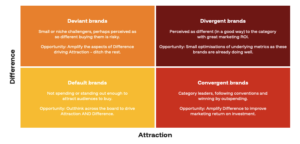
At Spark, we developed the Brand Divergence Index to help brands answer these questions with more confidence. BDI looks at how far a brand diverges from the category, and whether that difference creates attraction and purchase intent. It helps identify whether a brand is Divergent, Convergent, Deviant or Default.
In plain English:
- Divergent brand – different and attractive. It has a clear source of advantage.
- Convergent brand – attractive but too familiar. It may be liked, but it needs sharper distinction.
- Deviant brand – different but not attractive enough. It may need to make its difference more relevant, credible or valuable.
- Default brand – neither sufficiently different nor sufficiently attractive. It needs more fundamental strategic work.
The value is not just in the label. The value is in the decision-making that follows.
- What should we protect?
- What should we amplify?
- What should we fix?
- What should we stop doing?
- Where are we leaning too heavily on category codes?
- Where are our distinctive assets working?
- Where is difference creating attraction?
- Where is it creating confusion?
- Where are we underplaying something consumers would genuinely value?
That is where the conversation becomes commercially useful. And it is exactly what BDI was built for: to move the debate from internal opinion to external evidence, showing where your brand sits today, how it compares to the competitors you need to beat, and what to do next.
The Real Role of Brand Strategy
The best brand strategy does not simply make a brand look better. It makes the brand easier to choose. That requires more than a sharper line in a campaign. It requires a clear view of what the brand can own, how it should show up, what role it plays in people’s lives and how it can build memory over time.
Remarkable brands are rarely accidental. They are built through a series of choices.
- Choosing what category conventions to keep.
- Choosing what to challenge.
- Choosing which assets to build consistently.
- Choosing which consumer tensions to solve.
- Choosing where to be familiar enough to be understood, and different enough to be remembered.
That is the balance. A brand that is only familiar may be easy to understand but easy to ignore. A brand that is only different may be easy to notice but hard to want. A brand that is both different and attractive has the basis for advantage.
That is why the most important question for many brands is not “how do we make the next campaign better?” It is “are we giving the campaign something remarkable to work with?” Remarkable brands are built before the advertising starts. And the brands that understand that are far more likely to be noticed, remembered and chosen when it matters.